
What is Anti-Semitism in Repatriation?
For decades, museums and private collections have struggled with objects that were relocated during World War Two. The majority of these objects were forcefully taken by the Nazi’s from prominent Jewish households before and during World War Two (1939-45). The decades immediately following the war brought about hundreds of repatriation cases, with descendants of the prominent families asking for their paintings and decorative objects to be returned into their possession. For the sake of this project it is important to clarify immediately that repatriation has become the umbrella term for cases dealing with stolen art from the Nazi-Era and will be the main defining word on this module. These cases can also be defined as restitution or compensation cases.
While for some, the repatriation of stolen objects from World War Two is a clear-cut case of people receiving their stolen art back. However, several countries and institutions - such as Poland, Switzerland, and private foundations in Germany - have complicated this process and have passed laws and regulations limiting who can receive their belongings and whose possessions are forever stuck in the halls of museums and galleries. These laws and regulations are rooted in anti-Semitic sentiments that have hounded European governments since before the onset of World War Two. While only a few countries have explicit repatriation laws banning the Jewish community from receiving their objects back, many of these countries anti-Semitic sentiments and actions are shown in the resistance of said governments and museums to return objects back to their rightful owners. 1 As seen later in the module, many governments choose to turn the repatriation cases against the original owners - and rightful victims - and claim that the objects are critical to the history of the country.
In the twenty-first century repatriation has been heavily focused on the return of objects of cultural heritage back to their rightful homelands. 2 These returns have been brought to the forefront by a need to address the harmful affects of colonization on many countries around the globe. Due to this, objects stolen from their owners’ hands in the late 1930s and 40s, have relatively few cases received and repatriated by national governments every year. While some museums have made it known what objects are of Nazi-Era provenance or have given ownership rights to the original Jewish families, many objects remain unidentified or purposefully misidentified with critical ownership material left out. 3 However, with the rise of social media, private individuals seeking repatriation of their stolen artworks have brought their struggles into the spotlight. 4 Unsettling the topic of explicit and inexplicit anti-Semitism in Nazi-Era repatriation by looking at a specific case study, analyzing various texts and videos, taking a deep dive into the literature of repatriation case studies, and discovering other successful and unsuccessful repatriation cases through the exhibition “Who Owns It?”, will force museum professionals and goers to look upon objects of Nazi-Era provenance in a new and uncomfortable light until a change and tightening in repatriation laws and regulations specific to Nazi-Era objects occurs.
This digital resource module was created by Emily Harvey.
Emily Harvey is a Master's student at the Bard Graduate Center in New York City. With a background in Historic Preservation and Museum Studies, Emily has spent much of her career working with objects in collections focusing on high level United States military officials. Through this work Emily Harvey has developed an understanding and interest into the dealings between Europe and the United States after World War Two in terms of art and other objects of cultural heritage.
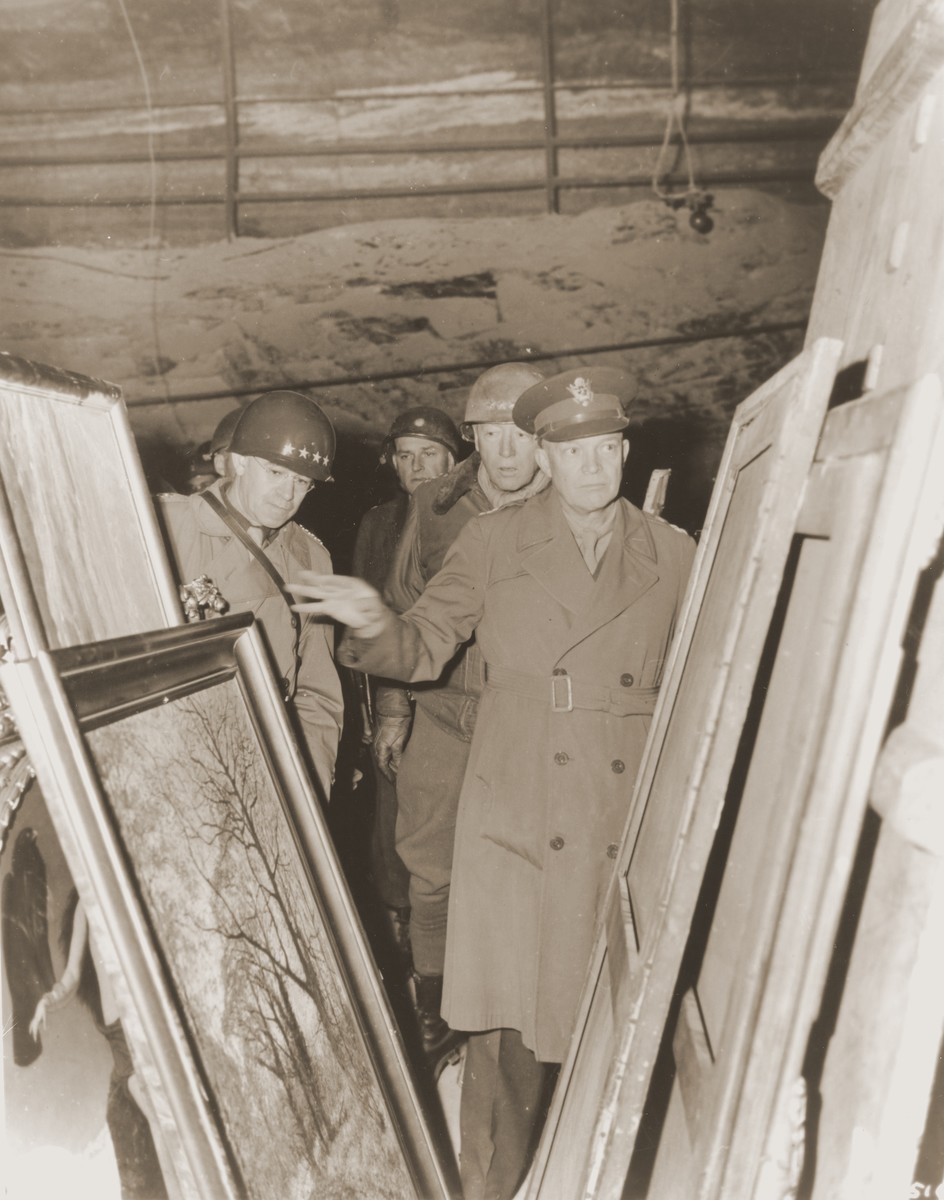
Figure 2: Moore/ General Dwight D. Eisenhower, Supreme Allied Commander in the West, accompanied by General Omar Bradley (left), and Lt. General George S. Patton, inspect stolen art treasures hidden in the Merkers salt mine. United States Holocause Memorial Museum.
Header Image (Figure 1): Monuments Men recovering the Ghent Altarpiece at Altaussee. Monuments Men Foundation.
- David M. Herszenhorn, "Israel recalls top diplomat from Poland citing 'anti-Semitic restitution law," Politico, August 15, 2021, accessed July 6, 2022, https://www.politico.eu/article/israel-diplomat-poland-anti-semitic-unethical-restitution-law/.
- The most notable case as of late is the return of the Benin Bronzes from multiple European and American institutions.
- See: O'Connor, Anne-Marie, The Lady in Gold: The Extraordinary Tale of Gustav Klimt's Masterpiece, Portrait of Adele Bloch-Bauer (New York: Alfred A. Knopf, 2012).
- Many museums have been called to action by art activits and the general public leaving comments on social media posts asking for the return of both cultural and fine art objects. While no one social media accounts has advanced in popularity, there are several that highlight specific objects and cases demanding their return.